On this page6 sections
Chappan bhog is a meal of 56 dishes offered to Bhagwan Krishna, Deity page on Tirth , and the reason people usually give for the number is a sum, eight meals a day for each of the seven days he held Govardhan Hill over Braj. The seven days come from the Bhagavata Purana.
As for the chappan bhog meaning, the name gives it away. Chappan is 56 in Hindi (and in Odia too), and bhog is food offered to a deity to eat. You’ll see it spelt chhappan bhog, chhapan bhog or just 56 bhog, and accounts from Puri write it Chhapan Bhoga.
In short
The seven days come from the Bhagavata Purana. As for the chappan bhog meaning, the name gives it away. Chappan is 56 in Hindi (and in Odia too), and bhog is food offered to a deity to eat. You’ll see it spelt chhappan bhog, chhapan bhog or just 56 bhog, and accounts from Puri write it Chhapan Bhoga.
Why 56? The sum of eight meals
Bhagwan Krishna ate eight meals a day, the telling goes, until Indra Dev’s storm beat down on Braj and he held up the hill for seven days. Seven days of that comes to 56 meals missed. So when the rain stopped, the people of Braj cooked 56 dishes, one for each meal he’d gone without.
Where the story turns up in print, nobody names a text for it: a news account from August 2024 files it under general information and common beliefs, a Hindi report puts it down to “mythological stories” and drops the eight meals, and where the Bhagavata is cited at all, it’s only for the lifting of the hill, with the 8 x 7 set down beside it.
In those three it’s the villagers of Braj at the stoves, while another version has Maa Yashoda making the 56 dishes to satisfy his hunger, and one more hands the kitchen to the gopis.
Other explanations are in circulation, offered as beliefs. There’s the lotus of 56 petals, in three layers, said to be in Bhagwan Krishna’s eternal abode, and one version of that gives every petal its own sakhi, or companion. Then there’s the six rasas (tastes), which can combine into 56 kinds of dish at most, so the argument runs, though the same writer drifts back to arithmetic in the end with seven days times the eight pahars, the watches of a day and night.
Does the Bhagavata ever count to 56?
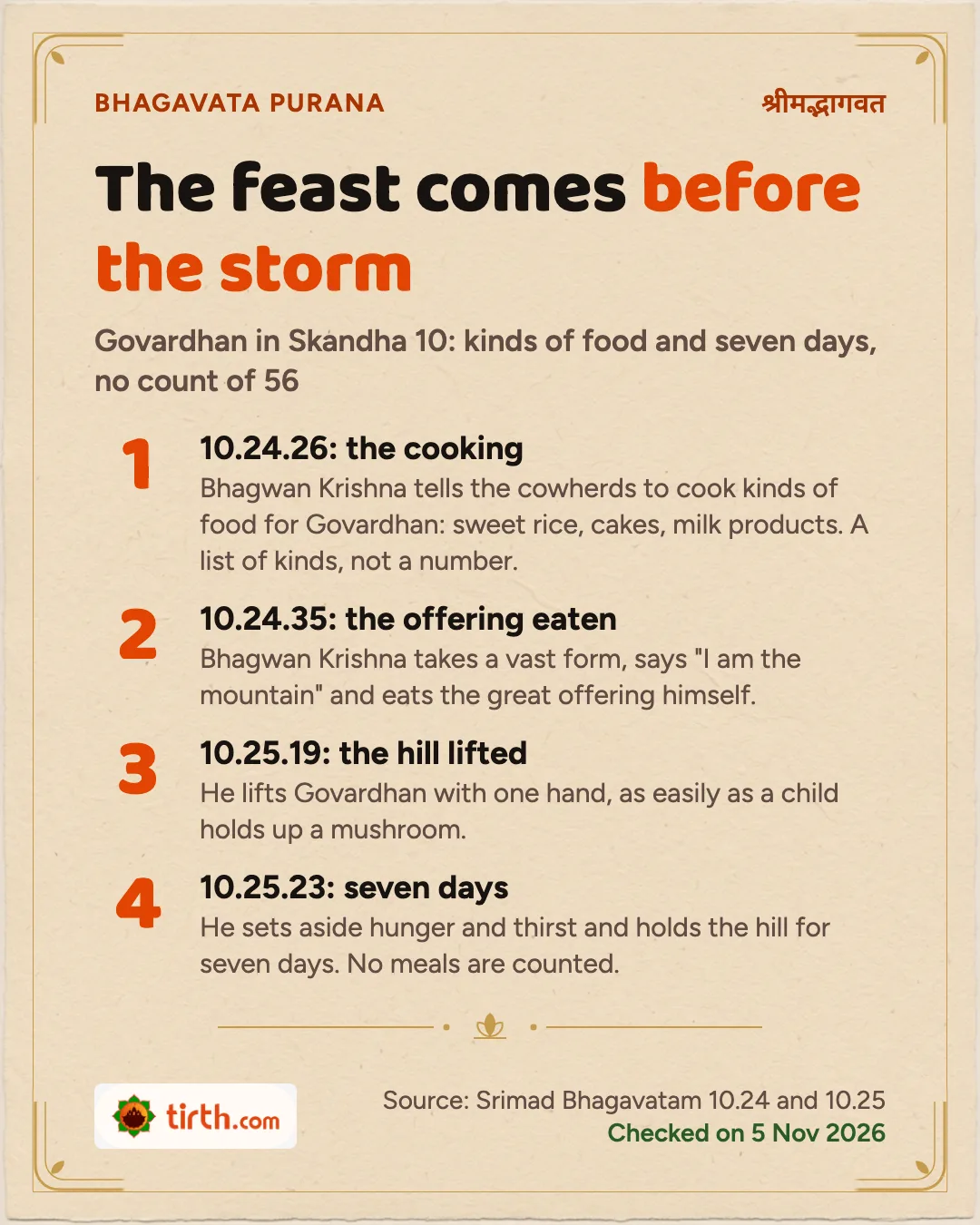
Skandha 10, chapters 24 and 25, which tell the Govardhan story, has the seven days and the kinds of food cooked for the first Govardhan puja, Spiritual Calendar on Tirth, but no verse there counts meals, let alone gets to 56.
It also tells things in the opposite order to the popular story, the feast coming first and the storm after. In chapter 24 the cowherds are getting a sacrifice ready for Indra Dev, and Bhagwan Krishna talks them out of it; spend the stores on worshipping Govardhan, he tells them. At 10.24.26 he even gives the menu, by kinds of dish rather than by number: liquid and vegetable dishes, sweet rice, fried and baked cakes, large rice-flour cakes and every kind of milk product.
Then, at 10.24.35, he takes another, vast form, says shailo ‘smi (“I am the mountain”) and eats the great offering himself, so that the cowherds can be at ease about what they’ve done. The first Annakut in the Bhagavata goes to Bhagwan Krishna, then, as the hill.
The storm comes in chapter 25. He lifts Govardhan on one hand at 10.25.19, as easily as a child holds up a mushroom (chatraka), and four verses on is the line the whole sum leans on.
At 10.25.23 the people of Braj watch him hold the hill for seven days (saptaham) without moving from the spot, setting aside the pain of hunger and thirst and his own comfort.
For the whole episode, from the cowherds’ first puja to the hill going back in its place, read the Govardhan Puja story from the Bhagavata.
Is chappan bhog the same as Annakut at Nathdwara?
The two meet on one day, which is where the mix-up starts. Annakut is just Govardhan Puja by its other name, kept on Kartik Shukla Pratipada, and the word means a mountain of food. In 2026 Govardhan Puja fell on Tuesday, 10 November (New Delhi), and the Govardhan Puja page of the Tirth Spiritual Calendar gives the date for your own city.
At Nathdwara the mountain is rice, and the Nathdwara Temple Board gives it by weight, a mound “weighing 125 maunds” standing for Govardhan, with a great variety of eatables laid out around it. The Board’s Annakuta account leaves the 56 out, and so do its accounts of Diwali and Janmashtami.
A Hindi news account has chappan bhog offered to Shrinathji at Nathdwara at every Janmashtami, and a Pushtimarg haveli in Vashi has held one for its Shrinathji temple’s foundation day.
The Board does call Shrinathji’s seva “often eight-fold”, following Bhagwan Krishna’s own day, with bhog in thousands of varieties.
Puri’s 56, and lists that refuse to agree
Puri has a 56 of its own. Chhapan Bhoga there, as two accounts describe it, is 56 items offered every day to Bhagwan Jagannath, Bhagwan Balabhadra and Maa Subhadra, sorted into rice dishes, sweets, pitha and cakes, milk preparations, and dals and curries. The count of 56 you see quoted for Puri comes from those accounts; the temple administration’s own Daily Rituals schedule simply names the day’s offerings.
Here is Puri’s grouping set beside two other published lists.
| Published list | Groups | Counts |
|---|---|---|
| The Puri list (two accounts) | Rice dishes; sweets; pitha, cakes and manda; milk preparations; dals and curries | 9, 11, 13, 9 and 14 (56) |
| A North Indian list | Milk products and basics; sweets and desserts; savouries and snacks; rice and grain; dals and curries; vegetable sabzis; then a chutney and one combined line of fruits, dry fruits, honey and pickle | 8, 20, 11, 5, 4 and 6 (54), plus the chutney and the combined line, which it says makes exactly 56 |
| A list of eight groups | Sweets; savouries; grains and breads; dairy; fresh fruits; dry fruits and nuts; drinks; pickles and accompaniments | 7 in each group (56), though its own text puts sweets at 18 to 20 kinds |
The sweets alone show how far apart they sit: 11 at Puri, 20 in the North Indian list and 7 in the eight-group list, whose own text then says 18 to 20 kinds. The lists more or less own up to this, saying the dishes change from region to region and from family to family and that the count isn’t always exactly 56. Several also say the bhog is kept vegetarian, with no onion or garlic, though no single rule binds every temple.
If you’re getting ready for Govardhan Puja at home, the Govardhan Maharaj aarti and the Bhagavata verse to Giriraj, with its word meanings, are both on Tirth and worth keeping to hand. And if you’d like to see the hill he held up for those seven days, begin with Govardhan and its parikrama.
Frequently asked questions
Literally, 56 offerings. Chappan is Hindi for 56 and bhog is food offered to a deity. Bhagwan Krishna receives it on Govardhan Puja and on Janmashtami, and at Puri a daily 56 is described as well.
Both. It’s part of Govardhan Puja (Annakut), and several tellings put it at the midnight puja on Janmashtami. A Pushtimarg haveli in Vashi has also held one for its temple’s foundation day.
Annakut is a day, Govardhan Puja by another name, and the word means a mountain of food (rice, at Nathdwara). Chappan bhog is the 56 dishes.
A daily offering of 56 items to Bhagwan Jagannath, Bhagwan Balabhadra and Maa Subhadra, in groups of 9, 11, 13, 9 and 14, according to two accounts.
Popular tellings name the villagers of Braj, Maa Yashoda or the gopis. The Bhagavata’s answer is the cowherds. They cooked for the first Govardhan puja, which Bhagwan Krishna had asked for, and he ate the offering himself in the form of the mountain.
Continue on Tirth
- Govardhan Puja in the Tirth Spiritual Calendar, with the date for each city.
- The Govardhan story from the Bhagavata, the whole episode.
- Janmashtami, the second day for chappan bhog.
- Govardhan, the hill in Braj and its parikrama town.